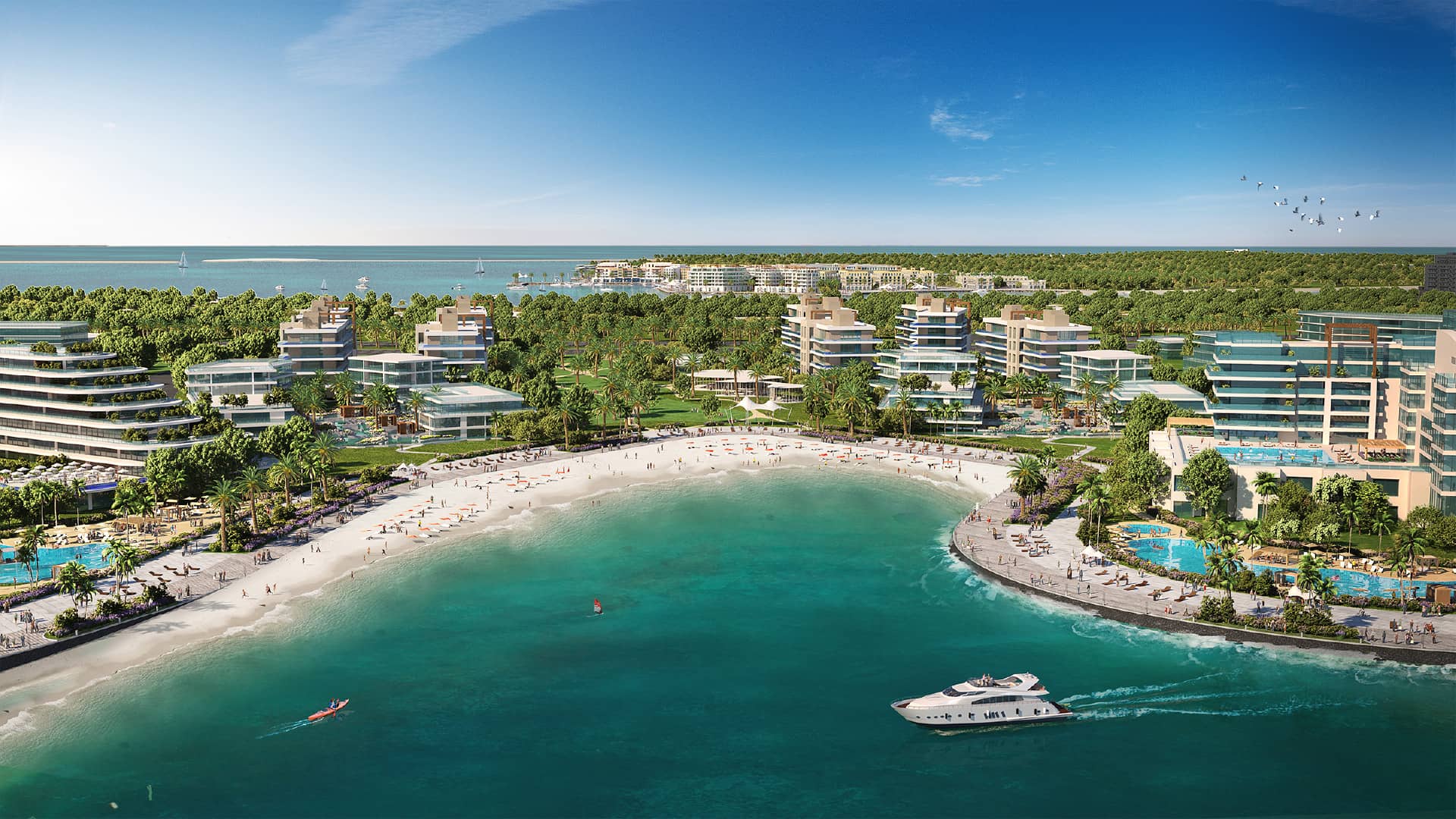
Emaar Beachfront is what Dubai Islands is trying to become, five years on, and that makes it the most useful comparison of the three. It is 21 percent more expensive per square foot, it out-yields Dubai Islands today, and it is also down 3 percent this year with transactions off a third. Read that last part twice, because it is the honest version of the bull case, not the brochure one.
It is worth seeing the Dubai Islands off-plan opportunity in the round before you judge the premium.
Every figure is from DLD, read on 29 August 2026. Here are the two side by side.
| Dubai Islands | Emaar Beachfront | |
|---|---|---|
| Price per sq.ft (DLD median) | AED 2,850 ▲ 17% YoY | AED 3,590 ▼ 3% YoY |
| Median price (DLD) | AED 2.89M | AED 4.1M |
| Gross rental yield (DLD) | No record yet | 7% |
| Net long-let yield, after costs | No record yet | ~5.1% |
| Service charge per sq.ft | AED 24 | AED 22–28 (cooling billed separately) |
| Stock and status | Off-plan, delivering 2025–2029 | Delivered 2020 onward, now softening |
| Drive to Dubai International | 10–15 min | ~30 min |
| How you buy | Off-plan, developer payment plans (50/50, 60/40) | Mostly secondary, mortgageable |
Source: the full price and rent benchmark.
The price curve, because it is the whole point of this page
Emaar Beachfront is the only real precedent for what a brand-new Dubai waterfront district does over time, so here is its actual price per square foot, year by year, from DLD:
2018: 1,800 · 2020 low: 1,600 · 2021: 2,200 · 2022: 2,800 · 2023: 3,200 · 2024: 3,500 · 2025 peak: 3,600 · 2026: 3,500.
From the 2020 low it ran up about 125 percent in five years, then came off 3 percent. That is the shape of a new district: a strong climb as it fills in, then a plateau or a pullback as supply lands. Other sites will tell you Emaar Beachfront went to 4,250 and use it as a straight-line forecast for Dubai Islands. It did not, and I will not. The curve rose hard and then softened, and both halves are the lesson.
Price: 21 percent, and closing
Dubai Islands is AED 2,850 per square foot, Emaar Beachfront is 3,590. That is a 21 percent gap, about AED 740,000 on a 1,000 square foot apartment. But watch the direction: Dubai Islands is up 17 percent this year while Emaar Beachfront is down 3. The two are converging, which is either your opportunity, if Dubai Islands follows the Emaar curve, or your warning, if Dubai Islands is climbing into the same plateau Emaar just hit. The 110 Dubai Islands projects at list price are here.
Yield: Emaar wins this one, and I am not going to pretend otherwise
Emaar Beachfront’s DLD gross is 7 percent. Its service charge is a genuinely low AED 22 to 28 per square foot, because Emaar strips cooling out to Tasleem and bills it to the tenant, so the owner’s recurring cost is small. Net it out with six weeks vacancy, 2 percent agency and 5 percent management and you land around 5.1 percent. That is a strong, real number.
Dubai Islands I will not put a figure against, because it is unlet and off-plan, and a yield on an empty building is a projection. My working expectation is 7 percent plus gross once it delivers, but that is a forecast in a sentence, not a return in a table. On today’s evidence Emaar out-yields Dubai Islands, full stop. Run the assumptions yourself, and here is how I calculate net yield.
Service charge
Close, and this is the surprise. Emaar Beachfront owners pay AED 22 to 28 per square foot, cooling billed separately to the tenant. Dubai Islands I model at AED 24, on a similar basis. So on running cost these two are roughly level, and both sit far below Palm. Here is why I model AED 24 and not 16.
The 79 developers point
This is the one argument on this page you will not read anywhere else. Emaar Beachfront’s price run came partly from a single master developer controlling the release pace, which supports prices on the way up and cushions them on the way down. Dubai Islands has 110 projects from 79 developers with no coordination on supply, all handing over into 2027 and 2028. That cuts both ways, honestly. No single hand steadying the market is a risk if demand softens. It is also why Dubai Islands is cheaper than Emaar today: you are being paid, in a lower price, to carry the supply risk Emaar’s structure absorbed.
What you are actually buying, and the exit
Emaar Beachfront is delivered from 2020, mortgageable, with a real rent record and a resale market, though volume is down 36 percent this year, so it is liquid but cooling. Dubai Islands is off-plan on payment plans, no rent record, no resale depth yet. Emaar is a proven district you buy after the proof, at a premium and into a softening tape. Dubai Islands is an unproven one you buy before, cheaper and on terms, carrying the supply risk yourself.
What it actually costs to buy, not just to own
The fee stack is the part comparisons ignore, and it leans toward Dubai Islands. Buying resale on Emaar Beachfront is a secondary transaction: 4 percent DLD, 2 percent agency plus VAT, trustee and registration near AED 4,200, and a developer NOC, roughly 6.3 percent in cash on the day, more like 7.5 percent once you add a mortgage arrangement fee, the 0.25 percent mortgage registration and a valuation. Dubai Islands off-plan costs the 4 percent DLD plus a small Oqood fee, no agency because the developer pays it, no NOC, and the price staged across the payment plan. Lower unit price, lighter fees, spread over years.
Financing, and when a mortgage is even available
Emaar Beachfront is delivered and mortgageable today: banks lend on it because it exists and has a rent record, so you can buy with a deposit and a loan now. Dubai Islands is developer-plan territory until handover. You buy on a 50/50 or 60/40, and a mortgage only enters at or near completion in 2027 to 2028, when you finance the remaining balance. If your plan depends on leverage from day one, Emaar can do it and Dubai Islands cannot yet. If you would rather stage cash against construction than carry a mortgage through the build, the Dubai Islands plan is the cheaper way to hold.
The verdict
If you want a delivered waterfront asset with a real 5.1 percent net and you accept you are buying after the run and into a pullback, Emaar Beachfront. If you want the cheaper entry, similar running cost, and you are making a considered bet that Dubai Islands follows the early part of the Emaar curve rather than arriving in time for the plateau, Dubai Islands. The case where neither works: if you need the yield to be certain, Dubai Islands cannot give you one yet, and Emaar’s is real but attached to a market that is currently going backwards.
On a matched apartment, in dirhams
A 1,000 square foot apartment is about AED 2.85M on Dubai Islands and AED 3.59M on Emaar Beachfront, a difference near AED 740,000. On Emaar, gross rent at 7 percent is roughly AED 251,000 a year, the low AED 22 to 28 service charge takes only about AED 25,000, and after vacancy and fees you keep a net near AED 183,000. That is strong income on a delivered asset. On Dubai Islands the same unit costs less and carries a similar AED 24,000 service charge, but produces nothing yet, because it is unlet. You are trading AED 183,000 of real income today for a AED 740,000 lower entry and a bet on tomorrow.
How deep is the market
This is where the softening shows. Emaar Beachfront signed about 622 new tenancies last year and its resale volume has fallen to between 14 and 62 apartments a month, with transactions down 36 percent year on year. Still a functioning market, but a cooling one, thinner than Palm and getting thinner. Dubai Islands’ 3,399 sales are almost all off-plan primary with no resale depth behind them. Neither gives you Palm’s liquidity: Emaar’s is contracting, and Dubai Islands’ has not been created yet.
Compare against the others: Palm Jumeirah and JBR.
Questions people ask
Is Dubai Islands cheaper than Emaar Beachfront?
Yes, by about 21 percent on DLD medians, AED 2,850 against 3,590, roughly AED 740,000 on a matched 1,000 square foot apartment. But the two are converging: Dubai Islands is up 17 percent this year while Emaar Beachfront is down 3.
What does Emaar Beachfront tell us about Dubai Islands?
It is the closest precedent for a new Dubai waterfront district. Emaar Beachfront ran from AED 1,600 per square foot in 2020 to a peak of 3,600 in 2025, about 125 percent, then softened to 3,500 in 2026. That climb-then-plateau is the realistic template for Dubai Islands, not a straight line up.
Which has the better rental yield, Dubai Islands or Emaar Beachfront?
Emaar Beachfront, on todays evidence. Its DLD gross is 7 percent and its owner service charge is low at AED 22 to 28, netting to about 5.1 percent. Dubai Islands is off-plan and unlet, so it has no real yield yet, only a projection.
Why is Emaar Beachfront more expensive than Dubai Islands?
It is delivered, proven and mortgageable, with a rent record and a single master developer that supported prices through the cycle. Dubai Islands is off-plan with 79 developers and no supply coordination, so its lower price is partly compensation for carrying that supply risk yourself.
Should I buy in Dubai Islands or Emaar Beachfront?
For a delivered asset with a real 5.1 percent net, accepting you buy after the run and into a pullback, Emaar Beachfront. For a cheaper entry with similar running cost and a considered bet that Dubai Islands follows the early Emaar curve rather than the plateau, Dubai Islands.