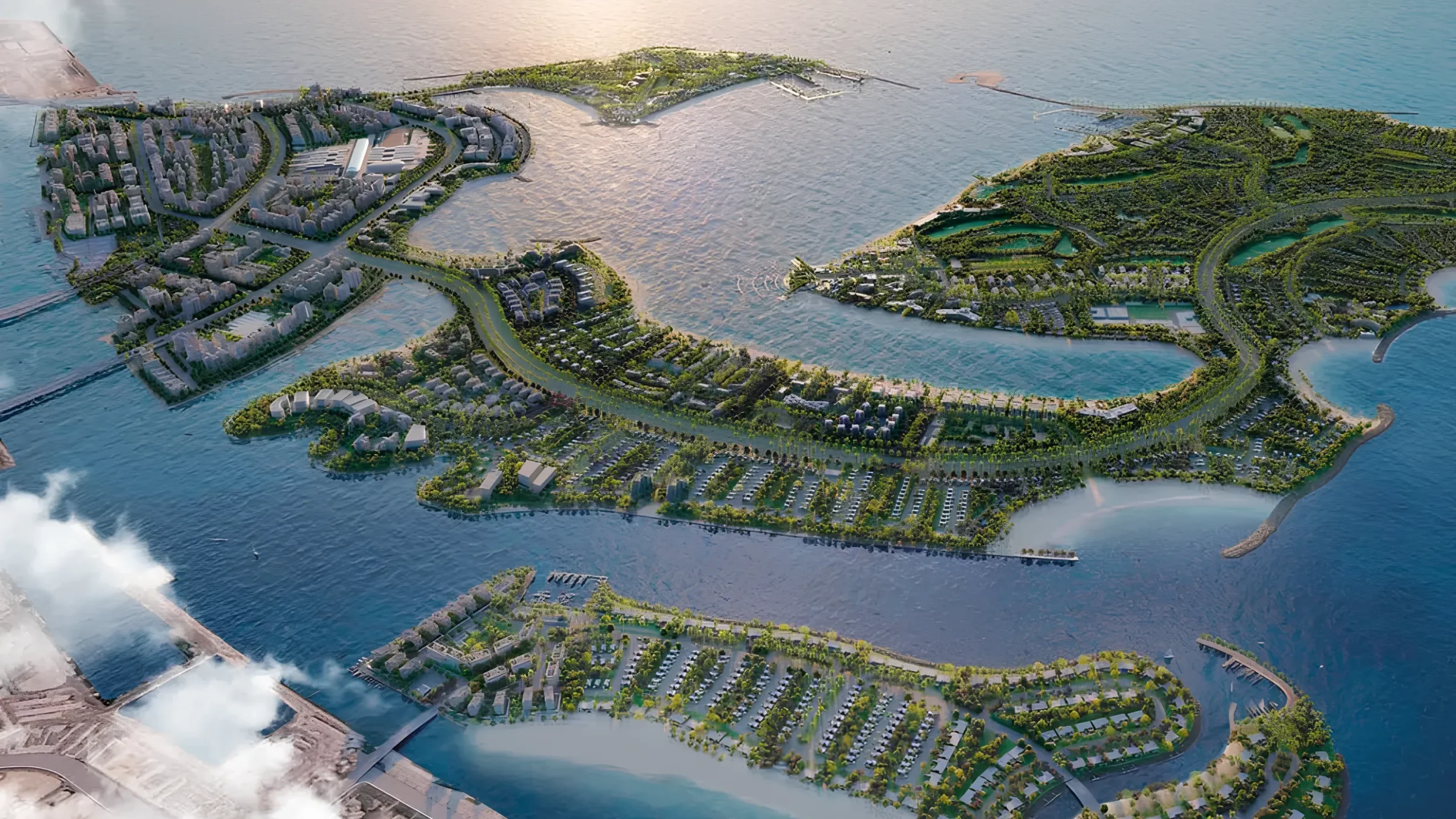
If you need rent landing in your account this year, buy Palm Jumeirah, and I will explain why in a moment. If you are underwriting a 2028 asset, Dubai Islands is about 22 percent cheaper per square foot than Palm, roughly AED 790,000 on a matched apartment, and it costs less to hold. What Palm gives you that Dubai Islands cannot is a delivered building with a decade of real rent behind it. That is the entire trade.
The discount only makes sense once you have looked at off-plan property on Dubai Islands in the round, not one tower in isolation.
Every figure below is from DLD, read on 29 August 2026, and both yields are worked the same way. Here are the two areas side by side.
| Dubai Islands | Palm Jumeirah | |
|---|---|---|
| Price per sq.ft (DLD median) | AED 2,850 ▲ 17% YoY | AED 3,640 |
| Median price (DLD) | AED 2.89M | AED 6.0M |
| Gross rental yield (DLD) | No record yet | 6% |
| Net long-let yield, after costs | No record yet | ~3.3% |
| Service charge per sq.ft | AED 24 | AED 50–70 (branded) |
| Stock and status | Off-plan, delivering 2025–2029 | Delivered, 2009 onward |
| Drive to Dubai International | 10–15 min | ~35 min |
| How you buy | Off-plan, developer payment plans (50/50, 60/40) | Secondary market, mortgageable |
The source is the full price and rent benchmark. Now the parts that decide it.
Price: the gap, in money rather than a percentage
Palm’s median is AED 3,640 per square foot. Dubai Islands is AED 2,850, and climbing fast, up 17 percent in a year as the launch pricing works through. On a 1,000 square foot apartment that is AED 3.64M against AED 2.85M, a difference of about AED 790,000. The gap is real, but it narrows every quarter Dubai Islands rises, so the “16 percent cheaper” line you will read elsewhere is already out of date. Today it is nearer 22 percent, and shrinking. If you want to see what AED 2,850 actually buys, all 110 Dubai Islands projects are here at list price.
Yield: where the quoted numbers come apart
You will be quoted 6 to 8 percent on both. Those are gross, and gross flatters everything. Here is Palm worked all the way through.
Palm’s gross rental yield on DLD is 6 percent. Take an apartment at that gross and do what an owner actually does: strip six weeks of vacancy, 2 percent agency, 5 percent management, and the service charge. Palm’s branded beachfront service charge is AED 50 to 70 per square foot, which on a 3,640 price eats close to 1.7 percentage points of yield by itself. What is left is a net of about 3.3 percent. That is the honest Palm number, roughly half the figure on the brochure.
Dubai Islands I will not put a yield against at all. It is off-plan and almost nothing has been let, so any figure is a projection on an empty building. My working assumption once these hand over is 7 percent plus gross, and I am telling you that in a sentence rather than a yield table for exactly that reason: it is a forecast, not a fact, and this site does not print forecasts as returns. You can run these assumptions yourself, and here is how I calculate net yield.
Service charge: where Dubai Islands actually wins
This is the number nobody puts in a comparison, and it is the one that turns the story around. Palm branded beachfront apartments carry AED 50 to 70 per square foot in service charge. Dubai Islands I model at AED 24. On a like-for-like beachfront apartment, Palm costs two to three times as much to hold every year. That is not a rounding difference, it is thousands of dirhams a year off your net, and it is why a 6 percent Palm gross nets so far below what it looks. Here is why I model AED 24 and not 16.
What you are actually buying
Palm is delivered stock from 2009 onward, with a functioning secondary market and a real rent record. You can see exactly what your building rents for, because it has been renting for years. Dubai Islands is off-plan, handing over 2025 to 2029, bought on a developer payment plan, with no rent history because nothing has been lived in. Those are different assets for different buyers. One is a known quantity you pay up for. The other is a district you are underwriting rather than observing, entered cheaply and on terms.
Exit and liquidity
Palm’s edge is here, and it is genuine. Deep resale market, mortgageable on the secondary, so your exit is a phone call to any agent in Dubai. Dubai Islands has 110 projects from 79 developers handing over into 2027 and 2028, a lot of similar stock reaching the market at once, and no resale depth yet because almost nothing has completed. If you need to sell in a hurry in 2027, Palm is the safer liquidity. If you are holding through the handover wave, that concentration is a risk the lower price is paying you to take.
What it actually costs to buy, not just to own
Most comparisons stop at the price and the yield and skip the fee stack, which is a mistake, because the stack is different on each side and it favours Dubai Islands in a way nobody mentions. Buying a resale apartment on Palm is a secondary deal: 4 percent DLD transfer, 2 percent agency plus VAT, trustee and registration of about AED 4,200, and a developer NOC. In cash that is roughly 6.3 percent on top of the price, all due on transfer day. Finance it and you add a bank arrangement fee near 1 percent, mortgage registration of 0.25 percent of the loan, and a valuation, which takes you past 7.5 percent before you hold a key.
Dubai Islands off-plan is a lighter stack. You pay the 4 percent DLD fee and an Oqood registration of a few thousand dirhams, and the 2 percent agency is paid by the developer rather than you. No secondary agency fee, no NOC, and the price itself is spread across a 50/50 or 60/40 plan instead of falling due in one payment. So on a matched apartment you pay less for the unit on Dubai Islands, a smaller percentage in fees, and you pay it over years rather than on a single day. Put your own unit through the cost calculator to see the real cash-in on each side.
The verdict
If you need income inside twenty-four months, or an exit on demand, buy Palm. It is delivered, liquid, and its yield after everything is a real 3.3 percent you can rely on. If you are underwriting a 2028 asset, can hold through the handover wave, and want a lower entry with a lower running cost, Dubai Islands is the cheaper and cheaper-to-hold way into the same water. The case where neither works: if you are chasing the 8 percent you were sold, walk away from both, because after costs that number exists on neither side.
On a matched apartment, in dirhams
Take a 1,000 square foot apartment on each side. On Dubai Islands that is about AED 2.85M today, plus roughly AED 185,000 to complete: the 4 percent DLD fee, trustee and admin, the first year of service charge and snagging. Your annual running cost is around AED 24,000, and there is no rent yet. On Palm the same 1,000 feet is about AED 3.64M. Gross rent at 6 percent is roughly AED 218,000 a year, but the AED 50 to 70 service charge claws AED 50,000 to 70,000 of that straight back, and after vacancy and fees you keep a net near AED 120,000. That is the real Palm number on a real unit: a 3.3 percent net on a AED 3.64M asset.
How deep is the market
Liquidity is Palm’s quiet advantage and it deserves numbers. Palm signed around 2,199 new tenancies in the last year and turns over roughly 50 to 120 resale apartments a month, a genuinely deep secondary market you can move in and out of. Dubai Islands has logged about 3,399 sales in the same period, but almost all of it is off-plan primary, not resale, because there is barely any completed stock to trade. Palm’s number is liquidity you can use today. Dubai Islands’ number is a launch queue. Both are large, they just mean different things.
Compare against the others: Emaar Beachfront and JBR.
Questions people ask
Is Dubai Islands cheaper than Palm Jumeirah?
Yes. On DLD medians Dubai Islands is about 22 percent cheaper per square foot, AED 2,850 against 3,640, roughly AED 790,000 on a matched 1,000 square foot apartment. It also carries a much lower service charge. Note Dubai Islands is rising 17 percent a year, so the gap is narrowing.
What is the real rental yield on Palm Jumeirah?
DLD gross is about 6 percent. Net, after the branded service charge of AED 50 to 70 per square foot, vacancy and fees, it comes to roughly 3.3 percent. The 6 to 8 percent figures quoted around Palm are gross, before any costs.
Does Dubai Islands or Palm have lower service charges?
Dubai Islands, by a wide margin. It models around AED 24 per square foot against Palm branded beachfront at AED 50 to 70. On a like-for-like apartment, Palm costs two to three times as much to hold each year, which is the single biggest reason its net yield is lower than the headline.
Why do you not publish a Dubai Islands rental yield?
Because it is off-plan and almost nothing has been let, so any figure would be a projection on an empty building. The working expectation once it delivers is 7 percent plus gross, but until there is a signed lease that is a forecast, not a return, and I will not print it as one.
Should I buy in Dubai Islands or Palm Jumeirah?
If you want income inside two years or an exit on demand, Palm, which is delivered and liquid at a real 3.3 percent net. If you are underwriting a 2028 asset at a lower entry and lower running cost and can hold through the handover wave, Dubai Islands. If you are chasing 8 percent, neither, because after costs it does not exist.